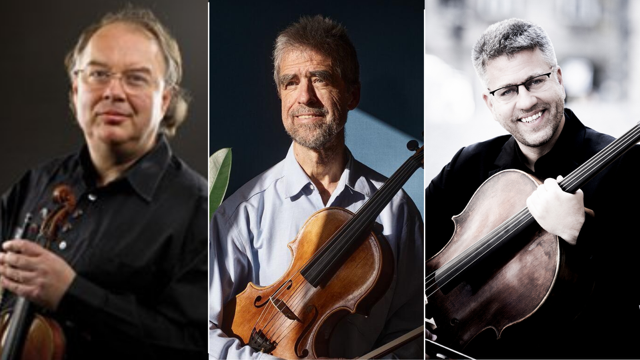
Erich Höbarth violin
Thomas Riebl viola
Peter Hudler violoncello
Works by
Wolfgang Amadeus Mozart
Duo in B flat major KV 424 for violin and viola, in the version for violin and five-string tenor viola by Thomas Riebl
Mieczysław Weinberg
String Trio Op. 48
- INTERMISSION -
Ludwig van Beethoven
Duo in E flat major for viola and violoncello, WoO 32, „Duett mit zwei obligaten Augengläsern“
Trio in G major for violin, viola and violoncello, Op. 9/1
What do the titans of Viennese classical music, Wolfgang Amadeus Mozart and Ludwig van Beethoven, have in common with Mieczysław Weinberg, a Jewish-Polish composer of the 20th century who found his artistic home in the Soviet Union? At first glance, they seem to be worlds apart - between classical and modern, enlightenment and post-war. And yet their works speak a common language: one of formal clarity, sympathy for human existence and, last but not least, a personal relationship to the theme of freedom.
Mozart's Duo in B flat major KV 424 was written in 1783 during his last stay in Salzburg. The trip was actually a family visit, during which he wanted to introduce his wife Constanze to his father Leopold - but the encounter was a cool one. At the same time, his friend Michael Haydn asked him for help: the cathedral organist had fallen behind schedule with a commission from Prince Archbishop Colloredo for six duos for violin and viola. Mozart stepped in without further ado and composed the two missing works, which were handed over under Haydn's name. The duo is composed in B flat major, so neither the bass note (B flat) nor the dominant (F) is available on a normal viola. We have Mozart's genius to thank for the fact that the piece is nevertheless completely rounded and harmonious. In his arrangement, Thomas Riebl nevertheless dares to exploit the lower range thanks to the F string of his five-string tenor viola; it allows for many logical voice leading and an expanded sound. Mozart's two duos are not only captivating as a prime example of classical balance and elegance in dialogue, but also as works with a subtle biographical undertone: music as a charming, self-confident gesture by a free artist.
The Polish-Jewish composer Mieczyslaw Weinberg (1919-1996) was painfully confronted with the loss of freedom throughout his life. His String Trio Op. 48, composed in Moscow in 1950, was never performed during his lifetime. The years between the end of the war and Stalin's death in 1953 were a difficult time for Weinberg: his father-in-law, the well-known actor and director Solomon Michoels, had been murdered by Stalin, and Weinberg himself was to be arrested after completing the trio. He was ultimately saved by Stalin's death. Despite this hardship, or perhaps because of it, the trio shows a multitude of facets: Enigmatic, cheerful passages alternate with mysterious, sombre moments, and folklore-like interludes provide rhythmic and melodic variety. Weinberg finally found his centre of life in Moscow and developed an unmistakable musical language: deeply rooted in the classical tradition. His Trio Op. 48 combines formal rigour, expressive power and poetic diversity - a work that exemplifies why he is considered one of the most important composers of the 20th century today.
After the interval, the programme turns to Beethoven, who is associated with unconditional individualism and the emancipation of the „genius artist“ more than almost anyone else. Musically, this power is expressed in creative freedom, the equality of the voices and the transgression of musical conventions - another impressive example of a personal exploration of the theme of freedom.
Beethoven's cheerful Duo in E flat major WoO 32 for viola and violoncello, also known as „Duet with two obbligato eyeglasses“, combines elegance, a good dose of humour and virtuosity. The conclusion and highlight of the matinee is the Trio in G major Op. 9 No. 1, an early masterpiece. Unlike Bach or Mozart, who grew up in a firmly established urban or corporative order, Beethoven published his first operas in the era of the revolutionary wars, a time of upheaval. The Trios Op. 9 combine almost symphonic ambition, virtuosity to the limits of what was playable at the time and chamber music intimacy and already show the young Beethoven as the composer who took chamber music from the aristocratic salon to the public concert hall. His striving for freedom, expression and creative power can be felt in every bar - musical qualities that we could also experience in Mozart and Weinberg.
Organised by Peter Hudler. Tickets from € 10,- to € 58,- in advance at celloexpansion.com (Link) and at the box office (cash payment only).